
Big Mountain Montana: The Complete 2026 Whitefish Guide

Big Mountain, Montana is the former name of what is now called Whitefish Mountain Resort, a 3,000-acre ski area in Flathead County that sits four miles from downtown Whitefish and roughly 20 miles from Glacier Park International Airport. The resort officially rebranded from Big Mountain to Whitefish Mountain Resort in 2007, though longtime locals and older maps still use the original name interchangeably.
Key Takeaways
Big Mountain officially became Whitefish Mountain Resort in 2007, but both names refer to the same 3,000-acre ski area with a 6,817-foot summit elevation, per Wikipedia's Whitefish Mountain Resort entry.
The mountain has 98 trails, 14 lifts including three high-speed quads, and a base elevation of 4,464 feet, according to SkiCentral.com resort data.
The 2026-2027 winter season is scheduled to run December 4, 2026 through April 4, 2027, and Whitefish Mountain Resort logged 500,187 skier visits in the 2024-25 season, its busiest on record.
The Danny On Memorial Trail climbs 3.8 miles one way from the village to the summit with about 2,353 feet of elevation gain, taking most hikers 2 to 3 hours.
Whitefish generated $87.4 million in visitor spending in 2023, representing 57% of the town's point-of-purchase spending that year, per Visa Destination Insights data cited by Explore Whitefish.
The Glacier Adventure Loft sits in downtown Whitefish, steps from the SNOW bus stop that runs to the mountain, and about a 30-minute drive from Glacier National Park.
Every winter, a wave of new visitors types "Big Mountain Montana" into Google and gets a slightly confusing answer: a mountain with a resort that goes by a different name today. That confusion is understandable. The peak itself is still called Big Mountain on topographic maps and in casual conversation around town. The ski operation built on its slopes changed its business name in 2007, but the terrain, the lifts, and the mountain's identity as the anchor of Whitefish's economy never went anywhere.
This guide sorts out the naming history, then gets into what actually matters for planning a trip: current trail statistics, the 2026-2027 season calendar, summer hiking routes on the Danny On Trail, and how Big Mountain compares to nearby resorts like Breckenridge and Big Sky in terms of terrain and crowds. At The Peak Properties, we manage a rental in downtown Whitefish and spend a lot of time answering exactly this question from first-time visitors, so we've built this around the details that actually change a trip: which lift runs in summer, how far the trailhead parking lot is, and what a low-snow winter like 2025-26 actually meant for skiers on the ground.
When Did Big Mountain Change Its Name?
Big Mountain officially changed its name to Whitefish Mountain Resort in 2007, a rebranding decision made to reduce confusion with other "Big Mountain" ski areas across the country and to tie the resort's identity more directly to the town of Whitefish. The mountain itself, the physical peak, kept its original name and still appears as "Big Mountain" on U.S. Geological Survey maps and in Flathead National Forest trail documentation.
Before the 2007 change, the resort operated under the Big Mountain name for decades, including through its 44th season by the early 1990s according to a 1991 Los Angeles Times feature that described it as a "well-kept secret" among western ski destinations. At the time, adult daily lift tickets ran around $29, with three-day passes at roughly $84, a stark contrast to current pricing that has climbed alongside every other major North American resort.
Locals still use both names constantly. You'll hear "we're headed up Big Mountain" and "let's ski Whitefish Mountain" in the same conversation, often from the same person. Explore Whitefish's own visitor information page, "A Little History of a Big Mountain," leans into this duality rather than fighting it, treating the name change as part of the town's story rather than something to correct visitors on.
What Is Big Mountain Called Now?
Big Mountain is now officially named Whitefish Mountain Resort, the name that appears on all current lift tickets, trail maps, and booking platforms as of 2026. If you're searching for current trail conditions, lift status, or season passes, search "Whitefish Mountain Resort" rather than "Big Mountain" to reach the resort's actual operational information at skiwhitefish.com.
That said, the legacy domain bigmtn.com still exists as a nod to the resort's history, and you'll find the Big Mountain name preserved in a handful of official contexts: the Big Mountain Trailhead on Big Mountain Road, the Big Mountain Fuels Reduction Project currently underway on the lower Danny On Trail, and Big Mountain Road itself, which is the main access route up from town.
For 2026, the distinction matters mostly for search purposes. If you're booking lift tickets, checking snow reports, or reserving a spot on a naturalist walk, use "Whitefish Mountain Resort." If you're asking a local for directions to a trailhead or talking about the peak in a general sense, "Big Mountain" works just fine and nobody will blink.

Where Is Big Mountain, MT Located?
Big Mountain sits in the Flathead National Forest in northwest Montana, about four miles from downtown Whitefish, 16 miles west of Columbia Falls, and 21 miles north of Kalispell. The mountain forms the western boundary of the Flathead Valley and sits close enough to Glacier National Park that many visitors combine both destinations in a single trip.
Specifically, the resort's base area sits at 4,464 feet, with the summit reaching 6,817 feet, a lift-served vertical drop of 2,353 feet according to SkiCentral.com's resort statistics. That vertical is respectable for a regional resort, though it's noticeably shorter than the roughly 3,400-foot vertical you'd find at Jackson Hole Mountain Resort or the 4,350-foot drop at Big Sky Resort, both frequently name-checked as comparison points for skiers weighing Montana and Wyoming options.
Getting there is straightforward. The closest commercial airport is Glacier Park International Airport in Kalispell, roughly 20 miles from the base of Big Mountain, and Whitefish also has its own Amtrak station connecting via Portland, Seattle, and Spokane on the Empire Builder route. If you're driving, Big Mountain Road climbs directly from downtown Whitefish, and the free SNOW bus runs guests from town lodging straight to the base area during winter operations, which means you genuinely don't need a rental car for a ski-focused trip based downtown.
That's a real practical advantage if you're staying somewhere like Glacier Adventure Loft, a 2-bedroom, 1-bath condo in the heart of downtown Whitefish that sits steps from the SNOW bus stop. You can ski all day, walk back into town for dinner, and skip the parking hassle entirely. The condo also puts you about a 30-minute drive from Glacier National Park, which matters if your itinerary includes both the mountain and the park in the same week.
Is Whitefish Mountain the Same as Big Mountain?
Yes, Whitefish Mountain Resort and Big Mountain refer to the exact same physical location and ski operation; the resort simply adopted the Whitefish Mountain Resort name in 2007 while the underlying peak retained its Big Mountain designation on geographic maps. There is no second mountain, no separate resort, and no meaningful difference in terrain, lifts, or trails between what older guidebooks call Big Mountain and what current websites call Whitefish Mountain Resort.
This gets confusing because search results mix both eras of branding. A 1991 LA Times article calling it Big Mountain and a 2026 resort press release calling it Whitefish Mountain Resort are describing the same 98 trails and the same 3,000 skiable acres, just separated by more than three decades of infrastructure upgrades, lift replacements, and a name change in between.
One helpful way to think about it: "Big Mountain" is the mountain's geographic identity, similar to how a city block might sit on a street with a historic name even after a building on it gets a new business sign. "Whitefish Mountain Resort" is the current business operating the lifts, lodges, and terrain on that mountain. Both terms are accurate. Neither is outdated in casual use, though official resort communications, season pass sales, and trail condition updates will always use the Whitefish Mountain Resort name.
What Are the Current Ski Terrain Stats at Whitefish Mountain Resort?
Whitefish Mountain Resort covers about 3,000 skiable acres served by 14 lifts, including three high-speed quad chairs, spread across 98 named trails according to SkiCentral.com resort data. The longest run stretches 3.3 miles from summit to base, and the resort averages around 300 inches of snowfall annually, giving it a reputation among Montana skiers as a reliably deep, tree-skiing-heavy mountain.
Terrain breaks down across beginner, intermediate, and expert zones, with one dedicated terrain park for freestyle skiers and riders. In winter, the resort also maintains roughly 9 miles of cross-country ski trails, a feature that gets less attention than the downhill terrain but is a genuine draw for visitors who want a quieter, non-lift-served option.
For the 2026-2027 season, Whitefish Mountain Resort is scheduled to open December 4, 2026 and close April 4, 2027, a window that gives you roughly four months of lift-served skiing. That's worth noting against recent trends: the 2024-25 season set a resort record with 500,187 skier visits, while the 2025-26 season saw 457,000 visits, an 8% drop attributed largely to a lower-snow winter. Even with that dip, 2025-26 still ranked among the resort's five busiest seasons on record, which tells you demand for Big Mountain skiing has stayed strong even when conditions weren't ideal.
Metric | Whitefish Mountain Resort (Big Mountain) |
Summit elevation | 6,817 ft |
Base elevation | 4,464 ft |
Lift-served vertical | 2,353 ft |
Skiable acreage | Approx. 3,000 acres |
Total lifts | 14 (3 high-speed quads) |
Named trails | 98 |
Longest run | 3.3 miles |
Average annual snowfall | Approx. 300 inches |
If you're comparing terrain against other Rocky Mountain destinations, ZRankings publishes a topographical ski resort survey that's useful for benchmarking vertical drop and pitch across resorts, including Breckenridge, which runs a noticeably larger operation with more high-speed lift capacity but also considerably heavier crowds on peak weekends.
How Does Big Mountain Compare to Big Sky and Jackson Hole?
Big Mountain is smaller and less crowded than both Big Sky Resort and Jackson Hole Mountain Resort, trading their bigger vertical drops and more extreme terrain for a shorter lift line experience and a lower price point on lift tickets. Big Sky's lift-served terrain spans a considerably larger footprint with steeper expert zones, while Jackson Hole is famous specifically for its aggressive, cliff-heavy terrain that draws a more expert-skewing crowd. If your priority is pure terrain volume or bragging rights about vertical feet, Big Sky and Jackson Hole both beat Whitefish Mountain Resort on paper. But if you're weighing a full trip, not just a mountain, Big Mountain wins on a few fronts that generic comparisons miss. First, lodging and dining in Whitefish stays meaningfully more affordable than Jackson, Wyoming, where prices run at a premium tied to the town's international profile. Second, Whitefish sits close enough to Glacier National Park that a single trip covers a ski day and a national park visit, something neither Big Sky nor Jackson offers as conveniently.
Crowds are the other differentiator. Even in its record-setting 2024-25 season, Whitefish Mountain Resort's 500,187 skier visits stayed well below what a destination resort like Big Sky or Jackson Hole typically sees in a comparable season, which translates into shorter lift lines and a more relaxed on-mountain pace, especially on weekdays.
What Hiking Routes Does Big Mountain Offer in Summer?
Big Mountain's summer hiking network centers on the Danny On Memorial Trail, a 3.8-mile route one way from the village base to the summit with about 2,353 feet of elevation gain, typically taking 2 to 3 hours depending on fitness level. The trail is named for a former resort employee and remains the most popular summer route on the mountain, connecting to several loop options for hikers who want a longer day.
Beyond the main Danny On climb, the resort maintains a handful of shorter loops. The Flower Point Loop adds 3.6 miles total, starting and ending at the summit, and pairs well with a lift ride up if you want to skip the steepest climbing. The East Rim Loop is a quick 1-mile option from the summit, offering views over the Flathead Valley and toward Glacier National Park without much elevation commitment. For a longer combined route, hikers often link the Danny On Trail with the Flower Point Loop for a roughly 5.4-mile one-way trek between the village and the summit.
A practical note for 2026: the lower third of the Danny On Trail is being rerouted this summer as part of the Big Mountain Fuels Reduction Project, a forest management effort. Check the resort's fuels reduction page before you go, since signage and trail access near the base can shift throughout the season.
If you'd rather skip the climb entirely, the resort runs a scenic chairlift during summer operations, taking about 20 minutes to reach the summit from the base area. That makes the summit accessible to visitors who want the view without the 2,353 feet of gain, including families with younger kids or anyone managing knee or hip issues. For a broader look at trail options in the surrounding valley, our guide to Whitefish outdoor activities covers the lower-elevation Whitefish Trail system in more depth.
What Family-Friendly and Accessible Options Exist on Big Mountain?
Big Mountain offers several lower-commitment options for families and visitors who want summit access without a multi-hour hike, most notably the scenic chairlift ride and the shorter East Rim Loop. Competitor guides rarely spend much time here, which is a gap worth filling since it's genuinely one of the more practical questions first-time visitors ask.
The East Rim Loop, at just 1 mile starting and ending at the summit, is the easiest maintained trail on the mountain and works well for families traveling with young kids or grandparents who want a short walk with a payoff view. The Bob Cedar Trail, a 1-mile connector from the Base Lodge into the broader Whitefish Trail system, is another gentler option that avoids steep grades.
The Big Mountain Trailhead on Big Mountain Road includes a large parking area with an ADA-compliant vault toilet, a detail that matters for visitors planning a day trip without resort lodging. From that same trailhead, hikers can also access 5.5 miles of the Whitefish Trail down to the Reservoir Trailhead, though that route involves roughly 1,600 feet of elevation loss, worth knowing before you commit to it as an out-and-back.
For winter visitors, naturalist-led discovery walks run along the Danny On Trail Thursday through Monday at 11 a.m. and 3 p.m., limited to 10 people per group. These are a nice option for visitors who want context on the mountain's ecology without committing to a full hike, though you'll want to call ahead at 406-862-1972 since spots fill quickly.
How Do Seasonal Crowds and Visitor Numbers Break Down at Big Mountain?
Big Mountain and the surrounding Whitefish area see distinctly different crowd patterns by season, with winter driven by skier visits and summer increasingly driven by Glacier National Park traffic and outdoor recreation. This is one of the biggest gaps in most Big Mountain guides, which tend to cover skiing in isolation without explaining how visitor volume actually shifts throughout the year.
According to Explore Whitefish data, the town recorded 1.45 million annual non-resident visitors in 2023, including both overnight and day or drive-through visitors. Visitor spending patterns have shifted meaningfully toward summer in recent years. July 2026 set an all-time high for monthly visitor spending in Whitefish at approximately $15.65 million, up 23% from July 2026's $12.74 million. That's a notable trend: Whitefish is no longer purely a winter destination propped up by ski season.
Winter spending is climbing too, just not as dramatically. January 2026 visitor spending reached $7.22 million, up 23.6% from January 2026's $5.84 million, even as overall skier visits dipped slightly that season due to lower snowfall. Air travel data backs up the seasonal squeeze: Glacier Park International Airport saw 86,954 passengers in July 2026 compared to just 26,391 in November, the slowest month, which tells you exactly when lodging and rental demand peaks.
For trip planning purposes, that means late November through early December (before the resort's December 4 opening) and April after the resort closes are genuinely quiet windows if you're trying to avoid crowds, though you'll trade off lift access entirely during those weeks. Early and mid-week visits during the regular season remain your best bet for shorter lift lines without sacrificing terrain access.
What Has Changed Recently on Big Mountain Due to Snowfall Trends?
Big Mountain experienced a below-average snow year in the 2025-26 season, contributing to an 8% drop in skier visits compared to the prior season's record. This is a detail most competitor content skips entirely, but it's directly relevant if you're deciding when to book a 2026-2027 season trip.
Even with that dip, the resort still landed among its top five busiest seasons on record, which suggests the drop in snowfall affected conditions more than it affected overall demand. Skiers who value guaranteed deep powder days should watch early-to-mid-season snow reports closely and stay flexible on exact trip dates if possible, since Whitefish Mountain Resort's terrain, heavy on glades and tree skiing, depends more on consistent base depth than a resort with more groomed, machine-made-snow-reliant terrain.
The upcoming 2026-2027 season's December 4 opening date gives the resort a full month of lead time before the historically busy holiday period, which is typically when lodging books up fastest in downtown Whitefish. If you're the type of traveler who tracks conditions before committing, plan your accommodation deposit for late fall but keep flexibility on exact ski days until closer to your trip, when snow reports firm up.
Where Should You Stay for a Big Mountain Trip?
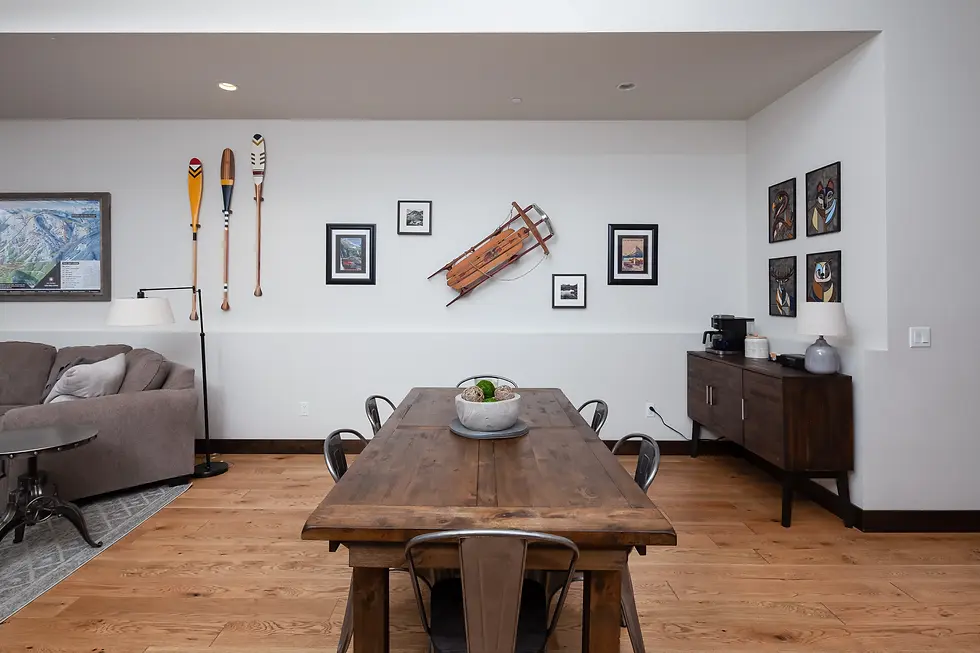
The best base for a Big Mountain trip is downtown Whitefish, which puts you within walking distance of restaurants and shops while keeping you connected to the mountain via the free SNOW bus rather than requiring a car for every trip up and down Big Mountain Road. Staying downtown also means you're positioned for both a ski day and a Glacier National Park excursion without switching lodging mid-trip. Glacier Adventure Loft is our top recommendation for exactly this reason. This 2-bedroom, 1-bath condo has 1,250 square feet of open living space with 20-foot ceilings, a king bed in the primary suite, and a lofted second bedroom that gives visiting friends or kids their own private space. It sleeps up to 4 guests comfortably, and its ground-level entry means no stairs to navigate with ski gear or luggage.
What makes this condo genuinely practical for a Big Mountain trip: it sits steps from the SNOW bus stop, so you can ski all day and walk back into downtown Whitefish for dinner without ever needing a rental car for mountain access. It's also about a 30-minute drive from Glacier National Park, making it a workable base for travelers combining both destinations in one week. The kitchen comes fully stocked with a Moccamaster coffee maker for early lift-line mornings, and the living room's Sonos Arc soundbar and fast WiFi make it a reasonable option for remote workers extending a ski trip into a longer stay.
Summer visitors get an added bonus: shared river access for kayak or paddleboard drop-in sits just across the street, and a walking path gets you to the beach in 10 to 15 minutes, useful once ski season wraps and Whitefish Lake becomes the main draw. If you're weighing lodging options more broadly, our complete guide to where to stay in Whitefish covers additional neighborhoods and property types beyond this single recommendation.
For visitors who prefer staying directly at the resort base, Kandahar Lodge is one of six hotel and condo properties located right on the mountain, a solid option if minimizing travel time to first chair is your top priority over walkability to downtown dining.
Practical Guidance: How to Plan Your Big Mountain Trip
Planning a Big Mountain trip well comes down to a handful of decisions made in the right order: pick your season first, then your lodging location, then your transportation plan. Skip any of these steps and you risk booking a rental that's technically "near" the mountain but requires a 20-minute drive every morning.
Decide winter or summer first. Winter means lift-served skiing from December 4, 2026 through April 4, 2027 for the current season; summer means hiking, the scenic chairlift, and Glacier National Park access. Both seasons now draw serious visitor spending, so neither is a clear off-season anymore.
Book lodging in downtown Whitefish if you want flexibility. Staying downtown, like at Glacier Adventure Loft, keeps you connected to the SNOW bus for the mountain and walkable to restaurants, avoiding the need for a car on ski days.
Check the fuels reduction project status if you're hiking. The lower Danny On Trail reroute affects access near the base through the 2026 summer season; confirm current signage at skiwhitefish.com before setting out.
Fly into Glacier Park International Airport. It's the closest commercial airport at roughly 20 miles from the base, more convenient than routing through a larger hub and driving several hours.
Watch snow reports if you're chasing powder specifically. Given the 2025-26 season's lower snowfall, stay flexible on exact ski dates rather than locking in a trip a year out based on average conditions.
Reserve naturalist walks or specialty activities in advance. Groups are limited to 10 people, so call ahead rather than assuming a walk-up spot is available.
One mistake we see often: visitors assume "close to Big Mountain" automatically means walkable to the lifts. It usually means a 10 to 15 minute drive up Big Mountain Road unless you're staying at one of the six on-mountain lodges. Downtown Whitefish lodging trades slope-side convenience for the SNOW bus connection, better dining variety, and typically better value.
Frequently Asked Questions
Is Big Mountain the same place as Whitefish Mountain Resort?
Yes. Big Mountain is the historic and geographic name for the peak, while Whitefish Mountain Resort is the current business name adopted in 2007 for the ski operation built on that mountain. Both names describe the same 3,000-acre ski area with 98 trails and a 6,817-foot summit.
What is the elevation of Big Mountain in Whitefish, Montana?
Big Mountain's summit elevation is 6,817 feet, with a base elevation of 4,464 feet, giving skiers a lift-served vertical drop of 2,353 feet. This data comes from SkiCentral.com's official resort statistics for Whitefish Mountain Resort.
How far is Big Mountain from Glacier National Park?
Big Mountain sits roughly a 30-minute drive from Glacier National Park's West Glacier entrance, making it feasible to combine a ski day or hike on the mountain with a park visit in the same trip. Glacier Adventure Loft in downtown Whitefish sits at that same approximate 30-minute distance from the park entrance.
When does the 2026-2027 ski season open at Whitefish Mountain Resort?
The 2026-2027 winter season is scheduled to open December 4, 2026 and close April 4, 2027, giving skiers roughly four months of lift-served terrain access. Exact dates can shift slightly based on early-season snowfall, so check skiwhitefish.com for confirmed opening status closer to the date.
Can you hike Big Mountain in the summer?
Yes, the Danny On Memorial Trail is the primary summer hiking route, running 3.8 miles one way from the village to the summit with about 2,353 feet of elevation gain and typically taking 2 to 3 hours. Shorter options like the 1-mile East Rim Loop and the connecting Flower Point Loop are also available for hikers who want less elevation commitment.
How many ski lifts does Whitefish Mountain Resort have?
Whitefish Mountain Resort operates 14 lifts total, including three high-speed quad chairs, serving 98 named trails across approximately 3,000 skiable acres. This puts it in the mid-size range compared to larger destination resorts like Big Sky or Jackson Hole.
Is Big Mountain better than Big Sky or Jackson Hole for skiing?
Big Mountain offers less overall terrain and a shorter vertical drop than Big Sky or Jackson Hole, but it typically has shorter lift lines, lower nearby lodging costs, and proximity to Glacier National Park that neither of those resorts can match. The right choice depends on whether you prioritize terrain volume or a lower-crowd, better-value trip.
Can I book a mountain rental near Big Mountain directly without using Airbnb or VRBO?
Yes, The Peak Properties allows direct booking of Glacier Adventure Loft and other properties through thepeakproperties.co, which avoids the added service fees typically charged by third-party booking platforms. Direct booking also gives you a direct communication line with the property manager for any pre-arrival questions.
Conclusion: Planning Your Big Mountain Montana Trip in 2026
Big Mountain and Whitefish Mountain Resort describe the same 3,000-acre mountain, the same 98 trails, and the same 6,817-foot summit; the only thing that changed in 2007 was the name on the business. What matters for your 2026 trip is timing it right: the current season runs December 4, 2026 through April 4, 2027, summer hiking on the Danny On Trail remains the best warm-weather draw, and Whitefish itself has become a genuine four-season destination rather than a ski-only town.
Whether you're chasing first tracks after a fresh storm or planning a summer hike up to the summit for the Glacier National Park views, downtown Whitefish remains the smartest home base for flexibility, dining, and access to both the mountain and the park.

If you're basing your Big Mountain trip out of downtown Whitefish, Glacier Adventure Loft puts you steps from the SNOW bus stop that runs straight to the mountain, no rental car required for ski days. Check availability here.
Written by Michael Leonard, Owner & Manager at The Peak Properties
Content powered by inkSTR.co


Comments